Black History as a Living Resource for Creatives, Educators, and Community Builders
Black History is far more than a chronological record of events—it’s a dynamic, living archive of resilience, innovation, cultural expression, and collective vision. It encompasses centuries of contributions across science, literature, music, fashion, architecture, and visual arts—often shaped under conditions of systemic exclusion yet radiating with unmistakable influence. For today’s educators, designers, nonprofit communicators, and community organizers, Black History isn’t just something to commemorate annually; it’s a rich, actionable resource that informs identity, inspires design, strengthens messaging, and fosters inclusive storytelling.
Yet many professionals face real challenges when seeking authentic, respectful, and high-quality visual assets rooted in Black History. Stock libraries often offer limited, stereotyped, or superficial representations—images that reduce complex legacies to clichés or isolated icons. Others struggle to find resources that honor nuance: patterns that reflect African textile traditions, Civil Rights-era symbolism, Afrofuturist motifs, or contemporary Black joy—without appropriation, oversimplification, or technical compromise.
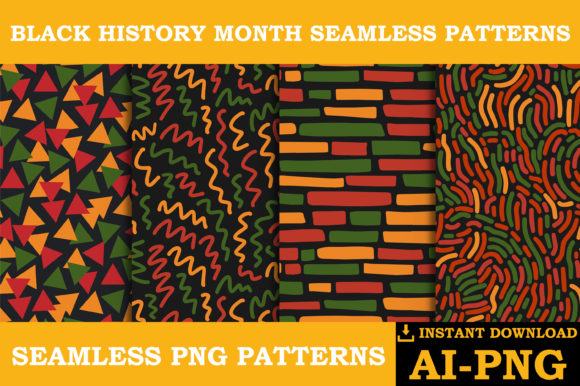
This is where intentionality meets utility. When you invest in purpose-built, culturally grounded design assets—like the 4 Black History Themed Seamless Patterns—you’re not just acquiring files. You’re gaining tools that support meaningful work: lesson plans that resonate with students, branding that reflects genuine inclusion, exhibition backdrops that deepen narrative impact, or social media campaigns that center dignity over tokenism.
What These Patterns Offer—and Why Resolution and Format Matter
Each pattern is delivered as a 6000 x 6000 px PNG file at 300 DPI—a professional-grade specification designed for real-world use. That resolution ensures crisp output whether you’re printing large-format banners for a museum exhibit, designing curriculum workbooks, or creating digital presentations for virtual classrooms. The seamless nature means effortless tiling across any surface—no visible breaks, no awkward repeats—giving your projects polish and cohesion.
But technical specs alone don’t tell the full story. What sets these patterns apart is their thematic depth and design integrity:
- Afro-Textile Revival Pattern: Inspired by Adinkra symbols, Kente geometry, and indigo-dyed resist techniques—reimagined with balanced negative space and modern color harmony.
- Harlem Renaissance Motif Pattern: Features subtle silhouettes of jazz musicians, vintage typewriter keys, and Art Deco flourishes—evoking intellectual vibrancy without literalism.
- Freedom Struggle Linework Pattern: Uses clean, bold linework to suggest protest signs, raised fists, and interwoven hands—symbolic but never reductive, powerful without being aggressive.
- Future Ancestors Pattern: Blends cosmic elements (stars, orbits) with West African cosmogram shapes and stylized natural forms—celebrating Afrofuturism as both heritage and horizon.
These aren’t decorative afterthoughts. They’re visual languages—designed to support goals like building classroom belonging, elevating Black-led organizations’ brand presence, or creating public installations that invite reflection rather than passive viewing.
Practical Applications Across Roles
Different users engage with Black History in different ways—and these patterns adapt accordingly:
Educators can integrate them into slide decks, handouts, or digital learning platforms to reinforce thematic units—from Reconstruction to the Black Arts Movement—without relying on overused clip art or low-res photos. A seamless background in a student workbook on Zora Neale Hurston subtly reinforces cultural continuity, while also making materials feel professionally crafted and worthy of the subject matter.
Nonprofit and advocacy teams use them to unify campaign visuals—whether designing posters for voter education, infographics on health equity, or reports on economic justice. Consistent, dignified pattern use builds brand recognition while signaling deep commitment—not just to Black History, but to Black futures.
Graphic designers and small business owners benefit from plug-and-play versatility. Layer a pattern behind transparent text for social posts. Use it as a subtle overlay on hero images. Apply it to packaging for a Black-owned tea company inspired by botanical traditions of the African diaspora. Because each file is high-resolution and seamlessly tileable, there’s no guesswork about scaling or repetition.
Museum and library staff rely on assets that meet archival and accessibility standards. These PNGs retain transparency support, embed cleanly in CMS platforms, and print flawlessly on everything from postcards to 8-foot-wide wall wraps—making them ideal for rotating exhibits, educator kits, or community event signage.
Using Black History Responsibly—A Practical Consideration
Access to culturally significant imagery carries responsibility. These patterns were developed with input from historians and designers familiar with regional symbolism, historical context, and contemporary usage norms. That means no sacred symbols are replicated without reverence, no movement iconography is used out of context, and no aesthetic is extracted without acknowledgment of its roots.
When incorporating them into your work, consider:
- Context is key: Pair patterns with accurate captions, citations, or QR-linked resources—especially in educational or public-facing settings.
- Avoid visual flattening: Don’t let the pattern become the sole representation. Use it alongside diverse voices, primary sources, and lived perspectives.
- Check your intent: Are you using Black History to enrich understanding—or to fill space? Let purpose guide placement, scale, and contrast choices.
Remember: Black History gains power through connection—not isolation. A well-chosen pattern shouldn’t distract from the message; it should deepen it.
Getting Started Is Simple—and Impactful
You don’t need a grand launch plan to begin. Start small: replace a generic background in your next newsletter with the Future Ancestors Pattern. Print one pattern on cardstock for a discussion prompt in your youth leadership program. Use the Harlem Renaissance Motif as a subtle border in a grant application for arts education funding.
What matters most is consistency and care. Over time, these intentional choices accumulate—shaping environments where Black History feels present, honored, and woven into the everyday fabric of learning, organizing, and creating.
Because Black History isn’t confined to February—or to textbooks. It lives in the colors we choose, the textures we repeat, and the spaces we design with respect and imagination. With tools built for both quality and meaning, you’re equipped to make that presence intentional, beautiful, and enduring.