Hummingbird Seamless Pattern - 1 Jpeg
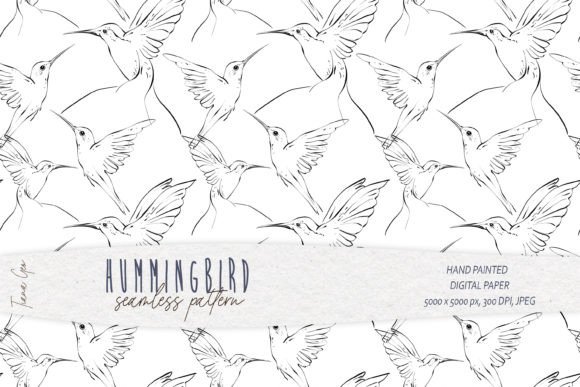
If you're designing fabric for a boutique clothing line, wallpaper for a wellness studio, or custom stationery for a wedding brand, the Hummingbird Seamless Pattern - 1 Jpeg delivers quiet sophistication with organic warmth. This isn’t a busy, over-rendered motif — it’s a thoughtfully composed watercolor floral pattern anchored by delicate line-art hummingbirds, built to repeat flawlessly across any surface without visible seams or visual fatigue.
The pattern breathes. Soft washes of muted sage, dusty rose, and warm ivory blend at the edges like pigment on damp paper. Hummingbirds are rendered in fine black ink — precise but light, with subtle wing motion suggested through tapering strokes rather than heavy outlines. Their posture feels intentional: hovering, not static; curious, not decorative. The florals are equally restrained — loose eucalyptus stems, tiny ranunculus clusters, and trailing vines that suggest growth without overwhelming the negative space. At 5000 × 5000 pixels and 300 DPI, it scales cleanly from a business card background to a 10-foot-wide wall mural — no pixelation, no loss of subtlety.
Where This Pattern Earns Its Place
Unlike trend-driven prints that date quickly, the Hummingbird Seamless Pattern - 1 Jpeg works where authenticity and tactility matter most. Think: natural skincare packaging printed on uncoated kraft paper — the watercolor texture complements the material instead of fighting it. Or linen napkins for a slow-living café, where the hummingbirds catch light differently depending on fold and drape. It’s equally effective on cotton poplin for a small-batch dress line, where the softness of the print mirrors the fabric’s hand-feel.
For digital use, it adds grounded elegance to social media templates — especially Instagram Story backgrounds or Pinterest pins for lifestyle bloggers. Because it’s a true seamless tile, you can crop and reposition freely in Canva, Photoshop, or Affinity Designer without breaking continuity. Scrapbookers appreciate how the fine line work holds up when laser-cut or die-cut, and educators use it as a subtle, nature-infused backdrop for printable lesson plans or student reward charts — calming but not childish.
Why Seamless Matters (Beyond the Obvious)
A seamless pattern isn’t just about technical convenience — it shapes how people experience your design. When a repeat breaks visibly, even subtly, it triggers a micro-level cognitive pause. Viewers don’t consciously register “that flower doesn’t line up,” but they *feel* the dissonance — a slight unease that undermines trust and polish. The Hummingbird Seamless Pattern - 1 Jpeg eliminates that friction. Its alignment is mathematically precise, yet visually imperceptible — the kind of craftsmanship that makes clients say, “It just looks *right*.”
This matters especially in environments where people spend time: bed linens, upholstery, or wallpaper. A poorly tiled pattern grows tiring over hours or days; this one invites lingering. That’s why interior designers choose it for boutique hotel rooms or co-working lounge walls — it supports atmosphere without demanding attention.
Practical Pairing & Placement Tips
You don’t need to overthink pairing — this pattern already carries gentle contrast between detailed line work and soft color fields. For typography, lean into clarity: a warm, humanist sans serif (like Poppins or Lato) balances its organic energy without competing. Avoid overly geometric or ultra-thin fonts — they’ll feel disconnected from the pattern’s tactile quality. If using on packaging, set product names in a modest weight and size, letting the hummingbirds and florals do the atmospheric lifting.
When applying to apparel, test scale first. At full size (5000 px), the pattern reads as an overall texture on a dress or tote — ideal for flowy silhouettes. Reduce it by 40–60% for structured pieces like blazers or shirt collars, where smaller repeats read as refined detail. On mugs or ceramic tiles, center the hummingbird focal point deliberately — one bird near the handle, another near the rim — to guide the eye naturally around the curve.
Licensing Clarity, No Guesswork
This is a commercial-use asset — meaning you can print it on physical goods you sell (textiles, stationery, home decor), use it in client projects (branding, editorial layouts), or integrate it into digital products (printable planners, Canva templates). You’re not buying a subscription or limited license — it’s yours to use, adapt, and reproduce without royalties or attribution requirements. Mockups aren’t included, which keeps the file lightweight and gives you full control over presentation. Just open the .jpg in your preferred editor and start building.
Real-World Adjustments You’ll Likely Make
Most users tweak saturation or contrast slightly — not because the pattern is flawed, but because screen calibration varies, and printing substrates absorb ink differently. On matte paper, you might lift midtone contrast by 5–8% to preserve depth. For dark fabrics, try overlaying a 10% white layer set to Multiply in Photoshop before printing — it lifts the watercolor luminosity without flattening the line art. And if you’re using it for scrapbooking, consider converting to grayscale first: the hummingbird linework stays crisp, and the florals become elegant tonal gradients.
One last note: this pattern thrives on restraint. Don’t layer it over busy photos or competing textures. Let it breathe — in margins, on single panels, as a subtle border or endpaper. Its strength lies in suggestion, not saturation. That’s what makes it timeless, not trendy.