Y2k Aesthetic 90s Digital Paper Pattern
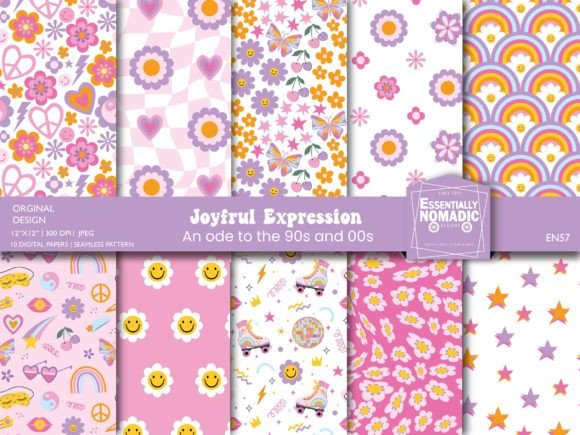
The Y2k Aesthetic 90s Digital Paper Pattern refers to a curated set of digital design assets inspired by the visual language of late 1990s and early 2000s pop culture—characterized by playful symmetry, bold yet soft color palettes, floral motifs with a digital twist, groovy geometry, and nostalgic UI elements like pixel hints or subtle gradient overlays. Unlike generic retro patterns, this aesthetic intentionally merges analog warmth (think Lisa Frank meets early web design) with crisp, modern digital execution. The pack described here contains 10 high-resolution JPEG files (3600×3600 pixels at 300 DPI), each designed as a seamless 12×12 inch tile suitable for print and digital craft applications.
People researching Y2k Aesthetic 90s Digital Paper Pattern often do so with a specific creative goal in mind: designing invitations for a millennium-themed birthday party, assembling scrapbook layouts that evoke childhood memories, or producing cohesive branding for a small business leaning into nostalgic appeal. Interest tends to stem from either a need for ready-to-use, copyright-cleared design elements or a desire to align visual output with a culturally resonant era—not just stylistically, but emotionally. The pastel palette (pink, purple, yellow accents) avoids harsh contrast while retaining enough vibrancy to read well across mediums, making it especially relevant for projects targeting younger audiences or those seeking approachable, cheerful visuals.
A key benefit of this particular pack is its technical readiness. All 10 patterns are seamless, meaning they repeat without visible breaks—critical for backgrounds, wrapping paper, or large-format prints. The 300 DPI resolution supports professional-grade printing on physical goods such as cupcake toppers, favor tags, or gift wrap without pixelation. Because the files are delivered as JPEGs in a single ZIP archive, setup is straightforward: no software dependencies, no licensing ambiguity beyond the stated copyright (© Essentially Nomadic Designs), and no subscription or recurring fees. For users working in Canva, Adobe Photoshop, Cricut Design Space, or Silhouette Studio, these files integrate without conversion steps.
However, there are tradeoffs to consider. JPEG format does not support transparency, so layered designs requiring cut-out shapes (e.g., die-cut labels or sticker outlines) will need additional masking or editing. Users needing vector-based scalability—for example, resizing a pattern to cover an entire wall mural—will find raster files limiting. Also, while the pastel palette offers cohesion, it may not suit projects demanding high contrast, monochrome schemes, or darker themes. The pack’s focus on floral and groovy motifs means minimal abstraction, typography integration, or grunge-influenced textures—elements sometimes associated with broader 90s/2000s design but absent here.
This Y2k Aesthetic 90s Digital Paper Pattern is a strong fit when your priority is speed, consistency, and thematic alignment over customization depth. It works well for event planners preparing multiple coordinated items (invitations + thank-you cards + food labels), educators creating themed classroom materials, or hobbyists building digital scrapbooks where visual harmony matters more than individual pattern manipulation. If your workflow relies on repeatable, print-ready assets—and you value a unified aesthetic rooted in optimistic, pre-smartphone-era digital optimism—this pack delivers predictably.
Alternatives may be worth considering in several situations. If you require editable source files (e.g., PSD layers for adjusting colors or adding text), vector formats (SVG or AI), or transparency support (PNG), then a different product—or custom design work—would better serve your needs. Similarly, if your project calls for historical accuracy over stylized interpretation (e.g., replicating actual GeoCities backgrounds or Windows 95 UI textures), more specialized resources would provide greater fidelity. For commercial use beyond personal or small-batch crafting, verify whether the license permits resale of derivative physical products—while the description notes copyright ownership, it does not specify usage scope beyond personal creative projects.
Practical decision-making starts with clarifying your output medium and scale. Ask yourself: Will these papers be printed at home on standard cardstock, or sent to a professional printer for bulk stationery? Are you designing one-off items or building a repeatable template system? If the answer leans toward the latter, seamless tiling and consistent resolution become essential—factors this pack addresses directly. Conversely, if your process involves frequent color adjustments, blending modes, or compositing with photographs, evaluate whether JPEG-only delivery introduces friction in your existing pipeline.
Also consider audience perception. The Y2k Aesthetic 90s Digital Paper Pattern communicates a specific tone: upbeat, inclusive, and gently ironic—not cynical or overly referential. It resonates most clearly with viewers who recognize the era’s optimism without requiring deep cultural literacy. That makes it effective for broad-appeal contexts like school fundraisers, boutique baby showers, or indie brand launches—but potentially mismatched for academic presentations, corporate rebranding, or projects aiming for minimalist or contemporary sophistication.
In summary, this pack serves a defined niche: creators seeking accessible, high-fidelity digital papers rooted in late-90s and early-2000s visual sensibilities. Its strength lies in reliability—not novelty. It does not replace design skill, nor does it claim to offer exhaustive stylistic range. Instead, it provides a focused toolkit for executing ideas efficiently when the aesthetic direction is already clear. Before acquiring, confirm that your intended use falls within the stated license terms, that JPEG compatibility aligns with your software and output needs, and that the color and motif emphasis matches your project’s emotional and functional goals.
If you're evaluating multiple digital paper options, compare not just visual style but file specifications, licensing clarity, and long-term usability. A well-chosen Y2k Aesthetic 90s Digital Paper Pattern can reduce production time significantly—provided it matches both your technical requirements and your intended message.