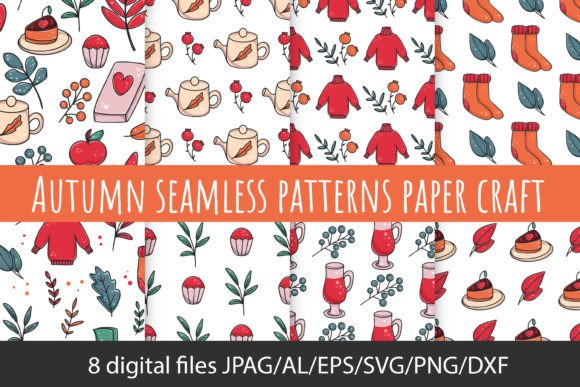
Autumn Seamless Paper Craft
Autumn Seamless Paper Craft isn’t just another seasonal design pack—it’s a versatile, production-ready toolkit built for real-world use across print, digital, and cutting machines. Whether you’re designing greeting cards for a small stationery shop, crafting social media templates for a fall-themed blog, or preparing classroom materials for an elementary art lesson, these hand-drawn digital paper backgrounds offer warmth, texture, and authenticity without the pixelation or repetition glitches common in lower-quality seamless patterns.
Why creators reach for Autumn Seamless Paper Craft—beyond the obvious
Most people download autumn-themed papers for their color palette: burnt umber, mustard gold, deep cranberry, and sage green. But what sets this pack apart—and why professionals keep it in rotation—is how thoughtfully each of the eight seamless patterns balances organic imperfection with technical precision. These aren’t AI-generated gradients masquerading as watercolor; they’re scanned textures and inked illustrations refined into truly repeatable, edge-to-edge tiles at 4000×4000 px. That means no visible seams when tiled across a large-format poster—or stretched across a full-page Canva template. And because every format is included (AL, EPS, PNG, SVG, DXF, JPG), you’re not forced to convert or resample, which preserves fidelity and saves hours of troubleshooting later.
A few overlooked details that quietly derail results
One of the most common missteps? Assuming “seamless” means “works everywhere out of the box.” It doesn’t—especially if your workflow relies on vector-based tools like Silhouette Studio or Cricut Design Space. A PNG file may look beautiful on screen, but it won’t scale infinitely or cut cleanly without rasterization. Similarly, using a JPG for layered print projects introduces compression artifacts near edges or text overlays—something that only becomes obvious after printing 50 invitations.
Another frequent oversight: skipping the AL (Affinity Designer) file entirely. While it’s easy to default to PNG or JPG for speed, the AL file contains editable layers—like individual leaf clusters or background washes—that let you adjust opacity, recolor elements, or isolate motifs for custom composites. Beginners often miss this flexibility, then spend extra time manually erasing or masking in Photoshop instead of simply toggling visibility.
And here’s one many don’t consider until it’s too late: DPI consistency across formats. This pack delivers all files at 300 dpi—critical for sharp letterpress prints or foil-stamped business cards. Yet some designers unknowingly open the SVG in Illustrator, scale it up 300%, and export at screen resolution (72 dpi), assuming “vector = always high-res.” Not true—export settings matter just as much as source quality.
What to verify before downloading—or worse, buying a similar pack elsewhere
Before committing, check three things—not just file count, but file *intent*. First, confirm resolution matches your end use: 4000×4000 px is ideal for A3+ print or full-bleed web banners, but if you only need Instagram Stories, smaller files would suffice (and load faster). Second, test one pattern in your primary software: drop the SVG into Cricut Design Space and try resizing to 24″ wide—if it stays crisp and cuts cleanly, you’ve got true vector integrity. Third, open the PNG in a layer-based editor and zoom to 400%: look for subtle banding, halos around textured edges, or inconsistent grain density. Those flaws rarely show in thumbnails—but they’ll show up in final output.
How to use Autumn Seamless Paper Craft more effectively—without overcomplicating it
Start simple: pick one pattern and apply it as a background layer in a document set to CMYK (for print) or RGB (for digital). Adjust blend mode to Multiply over light text or Overlay for subtle depth—this leverages the natural grain rather than fighting it. Avoid heavy filters or sharpening; the charm lies in its hand-drawn softness.
If you’re prepping for die-cutting or vinyl application, use the DXF or SVG files—not PNGs. Import directly into your cutting software, ungroup if needed, and check path continuity. A quick trace-and-clean in Inkscape or Illustrator takes two minutes and prevents mid-cut pauses caused by stray anchor points.
For educators or content creators building reusable templates, save time by creating a master file with all eight patterns as swatches in Affinity or Adobe software. Name them descriptively (“Maple-Leaf-Loose”, “Pumpkin-Wash-Soft”) so you can swap backgrounds without reimporting—ideal when iterating on lesson plans or client mockups.
When “more formats” actually means “more control”—not just convenience
The inclusion of AL, EPS, SVG, DXF, PNG, JPG, and even the high-res TIFF-grade PNGs isn’t about padding a product page. Each serves a distinct purpose:
- AL files let you edit strokes, adjust ink bleed, or tweak individual brush marks—ideal for customizing tone before exporting for print.
- EPS and SVG preserve scalability and are widely supported across professional print workflows and modern web platforms.
- DXF ensures clean, path-based cutting for craft machines—no auto-trace guesswork required.
- PNGs at 300 dpi give pixel-perfect transparency for layered digital designs (think email headers with overlapping foliage).
- JPGs work reliably for fast previews, CMS uploads, or quick social posts where transparency isn’t needed.
That variety means you’re not adapting the tool to your workflow—you’re matching the right format to the right task, reducing friction, revision loops, and last-minute format panic.
A final note on value versus volume
Some autumn paper packs offer 30+ patterns—but if half repeat the same base texture with minor hue shifts, you gain variety without versatility. This collection prioritizes distinct visual voices: one pattern mimics pressed botanicals, another evokes aged kraft paper with faint pencil lines, a third uses loose gouache washes. That diversity lets you differentiate branding across seasons or audiences—say, warm and rustic for a bakery’s holiday menu versus refined and minimal for a wellness coach’s autumn challenge guide.
So before adding another “fall background bundle” to your cart, ask: Does it include editable layers? Are all files truly 300 dpi and 4000×4000 px? Can I cut it, print it, and layer it—without conversion loss? If yes, you’re not just buying pixels. You’re investing in consistency, creative flexibility, and quiet confidence in your output.