Skulls Digital Paper, Skull Leopard: Seamless Texture Patterns for Real Creative Workflows
Skulls Digital Paper, Skull Leopard isn’t just another themed digital paper pack—it’s a production-ready asset designed to move with you through the full lifecycle of a creative or commercial project. Whether you’re designing party invitations at 9 p.m. on a Tuesday, prepping print-on-demand mug mockups for your Etsy shop, or building a cohesive brand mood board for a client pitch, this collection delivers consistency, flexibility, and immediate usability. Its strength lies not in novelty alone, but in how cleanly it integrates into existing tools, timelines, and output requirements.
What It Is—and Where It Fits in Your Workflow
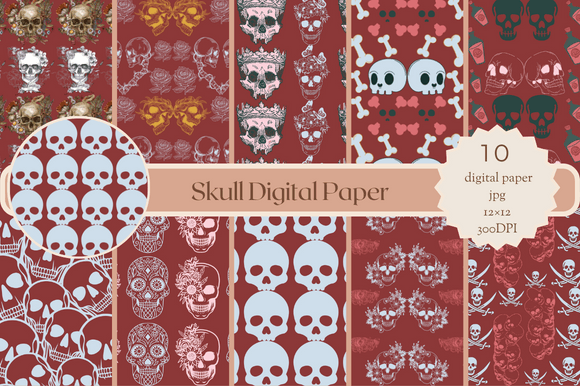
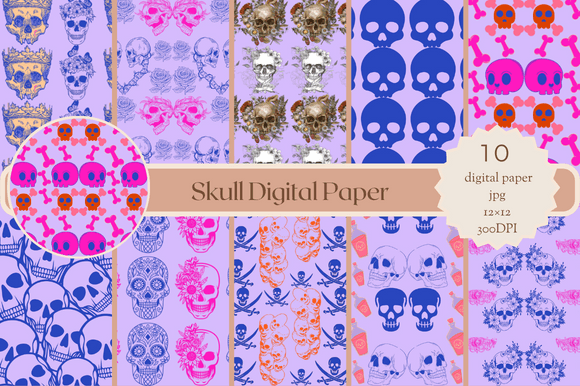
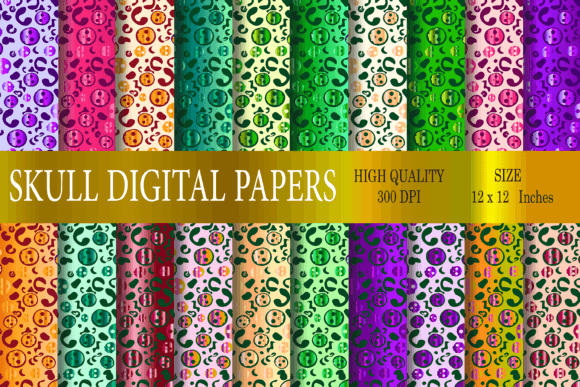
At its core, Skulls Digital Paper, Skull Leopard is a curated set of 20 high-resolution, seamless texture patterns—each rendered in four industry-standard file formats: SVG, PNG, EPS, and PDF. That means no guesswork about compatibility. You’re not downloading one version and hoping it works across platforms—you get native support for vector editors (Illustrator, Affinity Designer), raster-based tools (Photoshop, Procreate), cutting machines (Cricut, Silhouette), and even direct PDF embedding in Canva or InDesign layouts.
Unlike generic clipart or low-res downloads, these patterns are built for scale and repetition without visible seams or pixelation. The “Skull Leopard” motif blends edgy iconography with organic rhythm—ideal when you need visual impact without sacrificing sophistication. That duality makes it useful earlier in the process (mood boarding, concept testing) and later (final asset export, batch production).
Before the Project: Planning, Testing, and Alignment
Before committing time or budget to a full design sprint, use Skulls Digital Paper, Skull Leopard to validate direction. Load a few PNGs into a quick Figma or PowerPoint layout to test contrast, color harmony, and hierarchy against your typography or photography. Does the skull motif read clearly at thumbnail size? Does the leopard texture hold up next to metallic foil elements or matte paper stock previews?
For educators or content creators developing printable resources—lesson plans, workshop handouts, or planner inserts—previewing pattern density and spacing helps avoid overcrowding. A single 300 DPI PNG can be tiled across an A4 sheet in under a minute, giving instant feedback on how much visual “weight” the background adds before you layer text or icons.
During Execution: Efficiency Without Compromise
Once you’re in production, file format choice becomes tactical—not arbitrary. Use SVG files when scaling assets for responsive web banners or animated social posts; their crisp edges hold up at any size. Choose EPS when prepping for professional offset printing, especially if your vendor requires legacy vector formats. Rely on PDFs for multi-layered documents where transparency and embedded fonts matter—like invitation suites that combine die-cut outlines with foil-stamped text.
The 20-pattern structure supports variation without fragmentation. Instead of hunting for “just the right skull,” you have calibrated options: subtle tone-on-tone repeats for elegant stationery, bold black-and-white contrasts for t-shirt graphics, or warm-toned variants that pair naturally with kraft paper labels or tea towel dye techniques. That reduces decision fatigue mid-project—critical when juggling multiple clients or seasonal deadlines.
After Delivery: Repurposing, Archiving, and Scalability
A well-organized digital paper pack pays dividends long after launch. Because each pattern is delivered in four formats, you can archive by use case—not just by name. Keep SVGs in your “cutting machine templates” folder, PNGs in “web/social assets,” EPS in “print vendor handoff,” and PDFs in “client deliverables.” That system supports version control, too: if you update a color scheme for a rebrand, you only need to regenerate the PNG and PDF exports—not rebuild from scratch.
Small business owners often underestimate how quickly texture reuse compounds value. A single Skulls Digital Paper, Skull Leopard pattern used across cupcake toppers, favor tags, and thank-you cards creates subconscious continuity for guests—without requiring custom illustration for each item. That same pattern can later become the background for a limited-edition art print or the base layer for a sublimation-mug design, extending ROI across product lines and seasons.
Practical Integration Tips
- Batch import into design software: Most vector and raster apps support bulk import of PNG or SVG folders. Do this once, tag patterns by tone (e.g., “bold,” “subtle,” “warm”), and save as a reusable library—no more scrolling through 20 separate downloads.
- Match bleed and trim specs upfront: When using these for physical products like round wood signs or plates, open the PDF version in Acrobat and verify crop marks align with your manufacturer’s guidelines. The included PDFs are prepped for standard bleed zones, saving time in preflight.
- Test print on target substrates: A pattern that looks balanced on screen may shift dramatically on textured paper or ceramic glaze. Print one 4×6 swatch of each of the five most promising patterns on your intended material—then assess legibility, contrast, and tactile feel before mass production.
- Use transparency layers intentionally: The PNGs include alpha channels. Layer them over photos or gradients to create depth (e.g., a semi-transparent skull pattern over a sunset image for Instagram story backgrounds). This avoids flat overlays and adds dimensionality without extra blending modes.
Compatibility Beyond Software: People, Platforms, and Production Chains
Skulls Digital Paper, Skull Leopard bridges gaps between roles. A freelance designer can send SVGs to a client’s in-house marketing team for Canva edits. An educator can drop PNGs directly into Google Slides for student activity sheets. A craft entrepreneur can load EPS files into Cricut Design Space and cut matching vinyl decals and paper toppers simultaneously—ensuring perfect alignment across materials.
It also streamlines collaboration. When working with printers, packaging vendors, or fulfillment partners, delivering assets in their preferred format eliminates back-and-forth. No more converting files mid-process or risking unintended resampling. That predictability reduces revision cycles and keeps projects on schedule—even during peak holiday seasons or tight product launches.
Long-Term Usability: Quality Control and Consistency
Texture packs degrade in usefulness when resolution varies, naming conventions are inconsistent, or metadata is missing. Skulls Digital Paper, Skull Leopard avoids those pitfalls: every file is named clearly (e.g., skull_leopard_07_svg), uses identical color profiles (sRGB for web, CMYK-ready for print), and maintains 300 DPI minimum across all raster outputs. That means you can open any file, drop it into a new project, and trust it’ll behave.
For teams maintaining brand libraries, this consistency supports governance. Assign one pattern per campaign season—track usage in a shared Notion or Airtable log—and audit how often each variant gets deployed. Over time, that data reveals which motifs resonate most with your audience, informing future purchases or custom design requests.
Final Thought: Tools Serve Process, Not the Other Way Around
Skulls Digital Paper, Skull Leopard works because it respects how people actually work—not how software manuals say they should. It doesn’t ask you to learn new shortcuts or adopt unfamiliar workflows. It meets you where you are: in Illustrator refining a logo lockup, in Canva assembling a birthday invite, in Photoshop prepping a sublimation mockup, or even in a notebook sketching layout ideas before opening any app. Its value isn’t in being “trendy”—it’s in being dependable, adaptable, and quietly efficient across dozens of real-world scenarios.