Lunar New Year Chinese Digital Papers
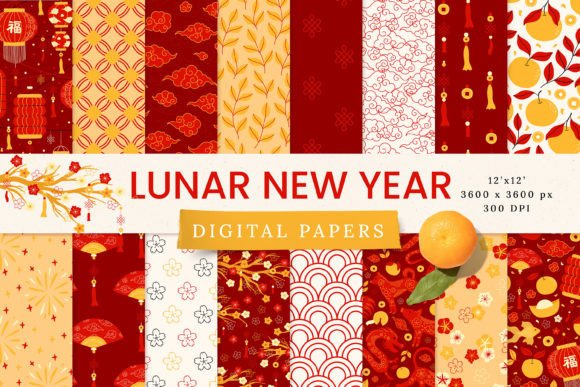
For designers, small business owners, educators, and creative professionals preparing for Lunar New Year, visual consistency and cultural authenticity matter—not just in final output, but in the foundational assets that shape every project. Lunar New Year Chinese Digital Papers is a curated set of 16 hand-painted seamless patterns designed to support real-world workflows where time, quality, and thematic integrity intersect. Unlike generic clipart or low-resolution stock textures, this collection bridges intention and execution: it’s built for use—not just display.
Each pattern is delivered in four formats—raster (.jpg and .png) and vector (.ai and .eps)—all sized to 12 x 12 inches at 3600 x 3600 pixels and 300 dpi. That means no last-minute upscaling, no pixelation on print runs, and no format-related roadblocks when switching between design tools or collaborators. Whether you’re using Adobe Illustrator for logo development, Canva for social media graphics, or Procreate for custom greeting cards, compatibility isn’t assumed—it’s engineered.
How These Papers Fit Into Your Creative Workflow
Digital papers rarely exist in isolation. They’re part of a chain: research → mood boarding → asset selection → layout → refinement → export → distribution. Lunar New Year Chinese Digital Papers enters most naturally at the asset selection and layout stages—but its value extends earlier and later in the process.
Before starting a project—say, designing a series of bilingual wedding invitations for a couple celebrating both Western and Lunar New Year traditions—you’ll likely gather references, define color palettes, and test motifs. Having 16 cohesive, culturally grounded patterns ready eliminates hours spent sourcing, editing, or licensing disparate elements. You can preview them side-by-side in your design software, apply them to mockups instantly, and assess how red-and-gold florals interact with calligraphic borders or watercolor-style lanterns—all before committing to a single layout.
During production, these papers serve as flexible substrates. Use them as background layers for greeting cards, as repeat tiles for digital wrapping paper, or as texture overlays in branding kits. Because they’re seamless, scaling across large-format prints (like wall art or fabric swatches) requires no manual tiling or edge correction. For educators creating printable classroom decorations—or freelancers building a client’s seasonal social media calendar—this saves measurable time without sacrificing resolution or fidelity.
Integration With Tools and Teams
Practical integration starts with file handling. The inclusion of both raster and vector files means you’re not locked into one workflow. Raster versions work reliably in Canva, Photoshop, Affinity Photo, and even PowerPoint for quick presentations or pitch decks. Vector files open cleanly in Illustrator, InDesign, and Figma—ideal when precision matters, like aligning patterns with typography or exporting SVGs for web use.
If you collaborate with printers, vendors, or clients who require specific file types, having .ai, .eps, .jpg, and .png covers standard expectations. No need to convert or explain why a “PNG looks fine on screen but won’t scale for foil stamping.” The vector files preserve scalability; the high-res rasters ensure accurate color rendering for CMYK print jobs. This reduces back-and-forth and version confusion—especially important when managing multiple deliverables across platforms (e.g., Instagram posts, printed menus, email headers, and physical gift tags).
For bloggers and content creators, these papers streamline seasonal content planning. Instead of rebuilding backgrounds monthly, you can batch-create templates: one Lunar New Year-themed Pinterest pin template, one newsletter header variant, one printable planner cover. Store them in a clearly labeled folder with naming conventions like LNY-Paper-07-Watercolor-Lanterns-AI. That level of organization supports faster iteration—and makes it easier to reuse or adapt assets across years without starting from scratch.
Use Cases That Go Beyond Decoration
While obvious applications include greeting cards, wall art, and wrapping paper, the real utility emerges in less intuitive contexts:
- Branding consistency: Apply a subtle paper texture as an overlay on website hero sections or brand guidelines PDFs to reinforce cultural tone without overwhelming readability.
- Educational materials: Teachers use these as printable backgrounds for vocabulary flashcards, festival timelines, or student-made zines—adding visual cohesion while supporting language and cultural learning objectives.
- Product packaging mockups: Insert patterns into 3D packaging templates (via Blender, Adobe Dimension, or CLO) to visualize how designs translate to physical goods like tea tins, cookie boxes, or stationery sets.
- Social media asset systems: Build a reusable Instagram Story grid where each slide uses a different paper as a base—ensuring visual variety while maintaining thematic unity across a 7-day campaign.
None of these require advanced technical skill. What they do require is assets that behave predictably—and these papers do. There’s no hidden transparency issue in the .pngs, no missing fonts in the .ai files, no inconsistent bleed or margin handling. That reliability feeds directly into efficiency and quality control.
Preparing for Long-Term Use
Treat these papers like durable tools—not disposable trends. Store them in a dedicated cloud folder synced across devices, with clear subfolders by format and use case (e.g., /Print/, /Web/, /Social/). Add metadata where possible: embed copyright info in XMP fields, note color profiles (sRGB for web, CMYK-ready for print), and keep a simple text log of which patterns worked best for specific outputs—like “Paper #12 performed well for foil-stamped invitations; Paper #3 added warmth to digital posters without washing out text.”
Also consider accessibility. While decorative, some patterns may affect text legibility if overlaid too densely. Test contrast ratios when placing light text over dark motifs—or vice versa. A quick check in browser dev tools or a plugin like Stark ensures inclusivity doesn’t get sidelined in seasonal design.
Finally, think beyond 2025. Lunar New Year repeats annually, but interpretations evolve. Revisit your usage notes each year: Which papers felt timeless? Which felt dated? Did certain motifs resonate more with your audience? That reflection turns a static asset library into a living part of your creative practice—one that grows sharper with each cycle.
What Makes This Set Distinct in Practice
It’s not just the number of papers—or even the formats. It’s how they’re made. Hand-painted origins mean organic variation: slight brushstroke texture, nuanced pigment blending, and intentional imperfections that avoid the sterile uniformity of algorithm-generated patterns. That humanity translates directly to viewer perception: warmth, craft, respect for tradition—not just aesthetic compliance.
In implementation, that difference shows up in subtlety. A vector-based gold foil pattern might look crisp but feel cold. A hand-painted red envelope motif carries weight, history, and intention. When used in a small business owner’s holiday email banner—or a freelancer’s portfolio site refresh—that nuance builds trust before a single word is read.
So whether you’re launching a limited-edition product line, prepping classroom resources, or updating your brand’s seasonal voice, Lunar New Year Chinese Digital Papers functions as infrastructure—not decoration. It supports decisions instead of demanding them. It fits into existing tools instead of replacing them. And it scales with your goals, not against them.