Owls in Seamless Vector Patterns: Precision Design for Print and Digital Projects
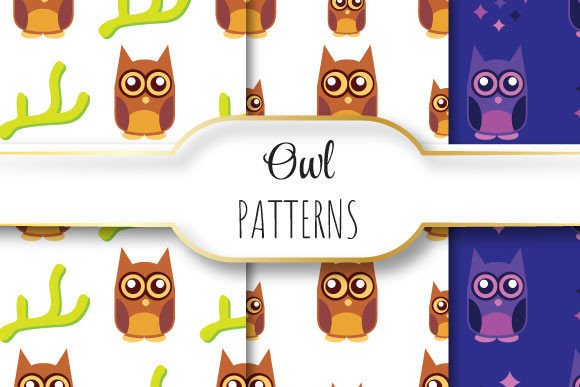
When designers seek timeless symbolism paired with technical versatility, owls consistently rise to the top—not just as icons of wisdom, but as remarkably adaptable motifs in vector art. This collection delivers exactly that: three meticulously crafted, seamlessly repeating vector patterns featuring owls, each built to professional print and digital standards. At 12 × 12 inches (3600 × 3600 pixels, 300 dpi), these files bridge creative ambition with production readiness—whether you're printing fabric, wrapping packaging, designing stationery, or building a branded web background.
Why Seamless Owl Patterns Stand Out in Modern Design
Seamless repetition isn’t just about visual continuity—it’s about scalability without compromise. Unlike raster-based repeats that blur or pixelate when enlarged, these EPS 10 vector files retain razor-sharp clarity at any size. That means an owl motif scaled to cover a 10-foot trade show banner looks identical in detail to the same pattern printed on a business card corner. The owls here are stylized with clean contours, balanced negative space, and intentional spacing—designed not just to look cohesive, but to *function* cohesively across surfaces.
Consider how this plays out in real projects:
- A boutique stationery brand uses one pattern for lined notebook covers, then zooms in to isolate a single owl for foil-stamped letterheads—same file, no redraws.
- An apparel designer applies the repeat across cotton poplin yardage, then extracts individual owl silhouettes to layer over embroidery digitizing software.
- A web developer exports the JPEG versions for responsive CSS backgrounds, knowing the 3600-pixel width ensures crisp rendering on high-DPI screens—even when tiled across a full-width hero section.
The owl motif itself adds narrative weight. It’s universally legible yet culturally flexible—evoking knowledge, intuition, quiet observation, or even playful mystery depending on context and color treatment. These patterns avoid cliché by balancing abstraction with recognition: feathers suggest texture without literalism; eyes anchor focus without overwhelming the repeat rhythm.
File Structure Built for Real-World Workflow
This ZIP package contains six files—three EPS and three JPEG—each pair sharing identical dimensions, alignment, and tiling logic. That pairing isn’t redundant; it’s strategic.
The EPS 10 files are fully editable in Adobe Illustrator, CorelDRAW, or Affinity Designer. All paths are outlined or live (depending on design intent), layers are named and grouped logically, and swatches are preserved—including global colors for easy recoloring. You can adjust stroke weights, swap fill gradients, or extract individual owl elements—all without breaking the seamless tile boundary. Because they’re saved in EPS 10, compatibility extends back to older design suites while retaining modern transparency and blending options.
The accompanying JPEG files serve immediate deployment needs. At 3600 × 3600 pixels and sRGB color space, they’re optimized for mockups, client previews, CMS uploads, or social media assets where vector support isn’t available. They’re not low-res placeholders—they’re production-ready raster counterparts, matched precisely to their vector siblings so what you see in Photoshop matches what you’ll output from Illustrator.
No hidden layers. No embedded fonts. No linked images. Just clean, self-contained files—ready the moment you unzip.
Practical Applications Across Industries
These owl patterns aren’t niche decor assets. Their technical specs and symbolic resonance make them unexpectedly versatile.
Textile & Surface Design
Fabric printers require large, tileable files with zero visible seams—and 300 dpi at 12 inches meets standard roll-fed textile printer input requirements. Whether you're developing a limited-run scarf line or licensing designs for wallpaper manufacturers, the consistent 3600-pixel grid ensures accurate registration during printing. Owls here are spaced with deliberate breathing room, avoiding overcrowding that can cause moiré in woven textures or ink bleed in screen printing.
Branding & Packaging
Repetition builds familiarity—and owls lend warmth to otherwise clinical packaging. A skincare brand might use a subtle monochrome owl repeat on kraft paper boxes, then lift a single owl into its logo lockup. Because the vector files include ungrouped elements, isolating that owl takes seconds—not hours of redrawing. The 300 dpi resolution also satisfies rigid retailer guidelines (like Target or Whole Foods), which often mandate minimum print resolutions for shelf-ready assets.
Digital Products & UI Elements
While vectors dominate app icon design, seamless JPEGs shine in UI backgrounds—especially in dashboards or educational platforms where “wisdom” or “learning” is a core theme. Teachers building interactive lesson slides can drop the JPEG directly into PowerPoint or Google Slides; the resolution prevents fuzziness when projected. Developers integrating into CSS or Figma can use the JPEG as a fallback while referencing the EPS for scalable icon variants.
What Designers Actually Consider Before Using Owl Patterns
Not all owl motifs work equally well across contexts—and not all seamless patterns behave the same way in production. Here’s what experienced users check before committing:
- Tiling integrity: Does the pattern truly vanish at edges? These files pass the “offset test”—when layered with a 50% horizontal/vertical shift in Photoshop, no seams or misalignments appear. That’s verified manually, not assumed.
- Color flexibility: Are fills built with global swatches or hard-coded CMYK values? These EPS files use named, editable swatches—so switching from navy owls on cream to sage owls on oat takes one click, not a find-and-replace slog.
- Scalability limits: While vectors scale infinitely, fine details like feather tips or eye highlights can collapse below 0.25 pt at extreme reductions. These patterns are tested down to 0.5-inch repeats—ensuring legibility even on small labels or embroidery patches.
- Licensing clarity: Each file is royalty-free for commercial use, including merchandise resale—but excludes reselling the pattern files themselves as standalone digital products. That boundary keeps usage simple and legally sound.
One overlooked factor? Intent alignment. An owl pattern meant for children’s books uses bolder shapes and friendlier proportions than one designed for luxury leather goods. These files lean into refined minimalism—clean lines, balanced density, and restrained detail—making them equally at home in a university press catalog or a Scandinavian homeware launch.
Getting the Most From Your Owl Pattern Collection
Start by opening the EPS files in Illustrator and checking the Layers panel. You’ll notice groupings like “Tile Boundary,” “Main Motif,” and “Background Fill”—a structure that speeds up customization. Want to add texture? Apply a grain effect to the “Main Motif” group only, leaving the background smooth. Need motion? Copy the tile, offset it slightly, and animate between states in After Effects using the JPEG sequence.
For print projects, always export a PDF/X-4 proof with crop marks and bleed set to 0.125 inches—this preserves vector fidelity while embedding fonts and transparencies correctly. For web, save JPEGs using “Save for Web (Legacy)” with 80–90% quality: sharp enough for retina displays, light enough for fast loading.
And remember—the owl isn’t just decoration. It’s a quiet signal. In a world saturated with noise, a thoughtfully repeated owl pattern invites pause, attention, and intentionality. That’s not just good design. It’s design that works—and endures.