Ice Cream Cones Seamless Vector Patterns
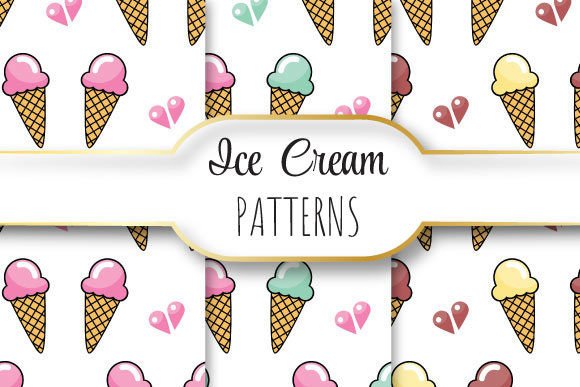
Ice Cream Cones refers to a curated set of seamless vector pattern designs centered around the playful, nostalgic motif of ice cream cones. Each pattern repeats smoothly across any surface without visible seams or breaks—making them suitable for applications where continuity matters, such as textile printing, packaging backgrounds, web design elements, or large-format wall graphics. The collection includes three distinct EPS vector files and corresponding high-resolution JPEG previews, all delivered in a single ZIP archive.
What Makes Ice Cream Cones Suitable for Design Projects?
Seamless vector patterns like Ice Cream Cones offer flexibility that raster-only assets cannot match. Because they are built in EPS 10 format, they retain full scalability without quality loss—ideal for projects requiring both small-scale labels and oversized murals. At 12 × 12 inches (3600 × 3600 pixels, 300 dpi), the included JPEGs serve as accurate visual references for color, density, and repeat behavior, while the EPS files preserve editable paths, layers, and transparency for further customization in Adobe Illustrator or compatible vector editors.
Why Might a Designer or Brand Consider This Collection?
Designers working on food-related branding, summer campaigns, children’s products, or lifestyle packaging may find Ice Cream Cones useful for adding thematic cohesion without overcomplicating layouts. The motif carries broad cultural recognition and positive associations—playfulness, refreshment, celebration—but avoids being overly literal or childish when applied with restraint. Its vector nature also supports efficient workflow: users can recolor shapes, adjust spacing, or isolate individual cone elements without degrading fidelity.
Key Benefits
- Scalability: EPS files scale infinitely without pixelation, supporting print and digital use cases at any dimension.
- Editability: Layers and grouped objects remain accessible in Illustrator, enabling quick adaptation to brand color palettes or layout constraints.
- Consistency: Seamless tiling ensures uniform appearance across repeating surfaces—critical for fabric, wrapping paper, or app interface tiles.
- Preview clarity: High-res JPEGs provide reliable on-screen reference for tone, contrast, and motif density before import into production software.
Tradeoffs and Practical Considerations
While versatile, Ice Cream Cones is not universally appropriate. Its thematic specificity means it works best when aligned with a project’s visual narrative. A financial services dashboard or corporate annual report would likely benefit more from neutral geometric or abstract patterns. Also, because the EPS files are saved in version 10, compatibility with very old vector software (e.g., pre-2008 Illustrator) may be limited—users should verify version support before purchase or licensing.
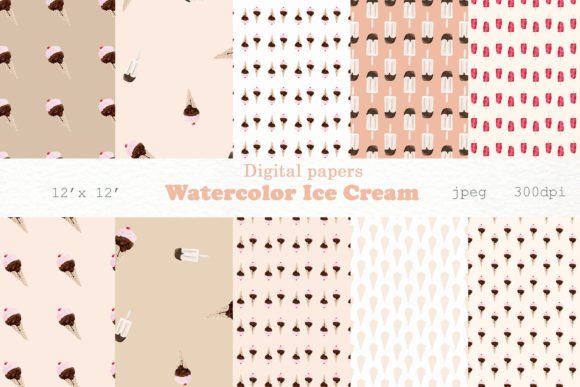
Another consideration is motif density. All three patterns vary in spacing and detail: one features tightly clustered cones with subtle shading, another uses simplified outlines with generous white space, and the third incorporates soft pastel gradients within each element. Users should evaluate which density best suits their intended output medium—for example, tightly packed patterns may lose clarity when printed on coarse fabric or viewed at small sizes on mobile interfaces.
When Is Ice Cream Cones a Strong Fit?
This collection is especially well-suited for projects where thematic resonance and technical reliability intersect. Examples include:
- Seasonal product packaging for frozen desserts, beverages, or confectionery brands seeking cohesive shelf presence.
- Children’s apparel or accessories where friendly, recognizable iconography supports target audience appeal.
- Digital assets for food delivery apps or dessert-focused blogs needing consistent background textures or UI accents.
- Interior design mockups for cafes or ice cream parlors aiming to visualize wall coverings or tabletop surfaces.
In these contexts, the ability to scale, recolor, and tile seamlessly directly supports production timelines and visual consistency—reducing the need for manual patching or custom illustration.
When Might Alternatives Be More Appropriate?
Designers with highly specialized requirements may find broader or more adaptable options preferable. For instance:
- If a project demands photorealistic texture rather than stylized repetition, high-resolution seamless photographic tiles—or procedural noise-based patterns—may better simulate material qualities like paper grain or brushed metal.
- If strict brand neutrality is required (e.g., healthcare, education, or B2B tech), abstract geometric or organic patterns without culturally loaded motifs offer wider applicability.
- If the goal is animation or interactivity, SVG-based patterns allow direct DOM manipulation and CSS-driven transitions—whereas EPS requires conversion and loses some dynamic capabilities.
- If file size efficiency matters for web use, optimized SVG sprites or CSS-generated patterns often outperform embedded EPS or large JPEGs in loading performance and responsiveness.
Decision-Making Guidance for Evaluation
Before selecting Ice Cream Cones, consider these questions:
- Does the motif align with your project’s message or audience? If “fun” and “refreshment” reinforce core brand values, the theme adds value. If not, it risks feeling arbitrary or off-brand.
- Do you require vector editability—or is a static preview sufficient? If you plan to modify colors, spacing, or composition, EPS access is essential. If you only need a fixed background image, JPEGs alone may suffice, though without scalability.
- What output mediums will you use? Large-format print benefits most from vector fidelity; digital-only projects may prioritize lightweight formats unless editing is needed later.
- How much control do you need over repeat behavior? All three patterns tile seamlessly, but their base tile dimensions (12 × 12 inches) assume standard scaling. Unusual aspect ratios or non-square layouts may require manual adjustment to avoid unintended cropping or alignment issues.
Also note that the ZIP contains exactly three EPS and three JPEG files—no variations in orientation, color mode, or alternate formats. Users expecting CMYK-optimized print files, Pantone swatches, or additional file types (e.g., AI or PDF) should plan for in-house conversion if needed.
Final Considerations
Ice Cream Cones delivers focused utility—not broad versatility. Its strength lies in executing a specific visual idea with technical precision. It is neither a substitute for original illustration nor a replacement for comprehensive pattern libraries covering diverse themes and styles. Rather, it serves as a purpose-built tool for designers who have already determined that a cheerful, scalable, seamless ice cream cone motif meets a defined creative or production need.
Evaluating whether it fits your work involves matching its attributes—vector scalability, thematic clarity, and seamless tiling—to your project’s functional and aesthetic requirements. When those criteria align, Ice Cream Cones provides predictable, professional-grade assets ready for integration into established design workflows.